Polo
One room for the whole mix. Drop the Sum on a return, put a Send on every track, and place each instrument by how far away it stands.
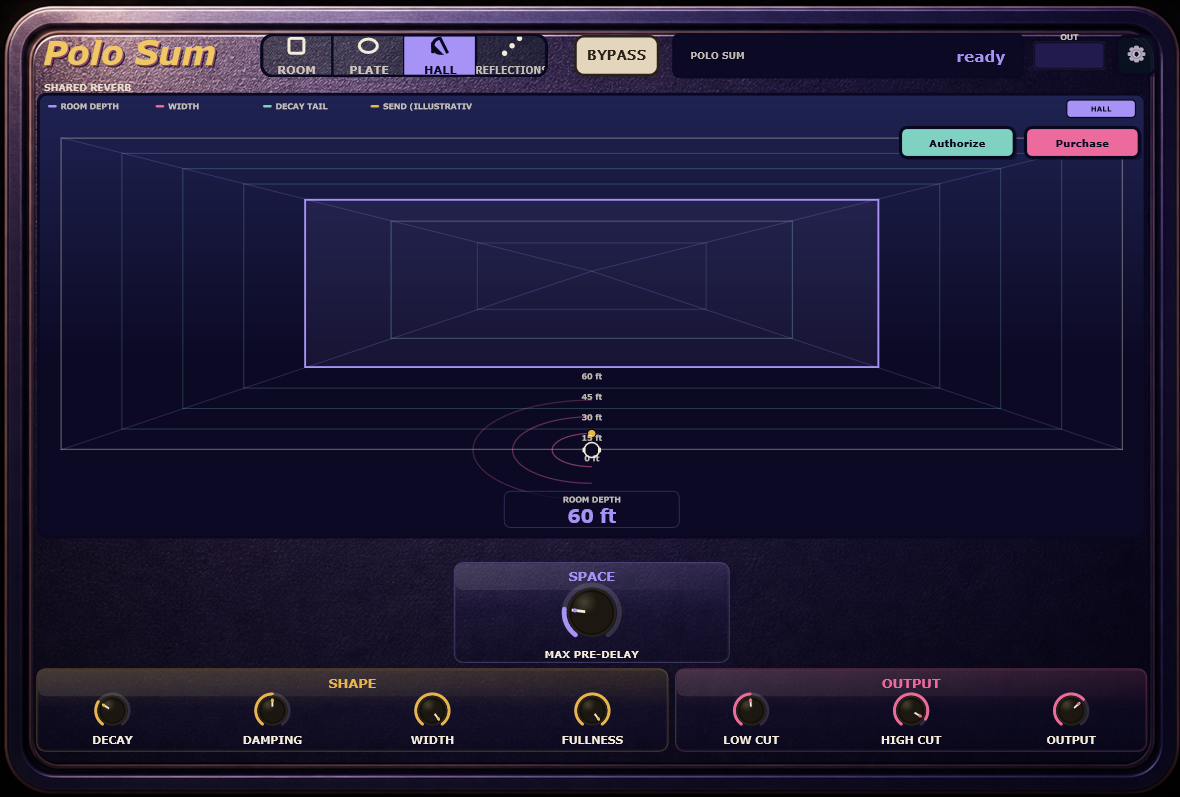
One room, every instrument, each at its own distance.
Loading a separate reverb on every track gives every instrument its own, disconnected acoustic: a drum plate here, a vocal hall there. Polo takes the opposite approach: Polo Sum is a single shared reverb living on one return, and every track reaches it through Polo Send. Because every source shares the same tank, they all read as occupying one real space instead of a stack of unrelated effects.
Distance is the primary control. On each Send, 0% sits at your face (the listener, full pre-delay) and 100% sits at the far wall, where the reverb arrives together with the dry signal. Tilt biases where the reverb image sits left or right, independently of the dry pan. A Send at 50% is literally halfway into whatever depth the Sum's room is set to: the two plugins share one metaphor.
The Send never touches the dry signal. Distance, Tilt and Level only shape what reaches the shared room, so you can place the drummer at the back wall and the vocal at your face, all breathing the same air, without moving a fader.
The interface, explained.
Polo Send is the small, glanceable tap on every track. Polo Sum is the hero window where the room itself is designed.
Distance + Tilt
Drag the dot from your face to the far wall to set how deep in the room the track sits; slide it left or right to tilt where its reverb image lands.
Feed the room
Level sets how hard the track feeds the shared reverb. Duck keeps the room out of the way while the track plays, blooming back between phrases.
Pick the space
Room, Plate, Hall or Reflections. One selector sets the character of the space every Send is feeding.
Size the room
Sets the physical depth of the whole room: the distance every Send's placement is measured against.
Decay · Damping · Width
How long the room rings, how fast the top dies away, and how wide the tail spreads.
Low Cut · High Cut · Output
Trim the tail into the mix: clear the mud below, soften the air above, set the return level.
Polo, answered.
What is Polo?
A shared-reverb pair: Polo Sum is one reverb on a return bus, and Polo Send is a lightweight tap on each source track that places it in that room by distance. Every instrument ends up in the same space, each at its own depth.
Is Polo like Marco?
They're siblings by name (Marco… Polo) but do different jobs. Marco places sources in the stereo field; Polo manages musical reverb: one shared room, with per-track distance, tilt and level into it.
Does Polo Send change my dry signal?
No. Distance, Tilt and Level only shape what reaches the shared reverb. The dry pass-through on the track is completely untouched.
Put every track in the same room.
The whole pair is free to try. One purchase includes Polo Send and Polo Sum.